
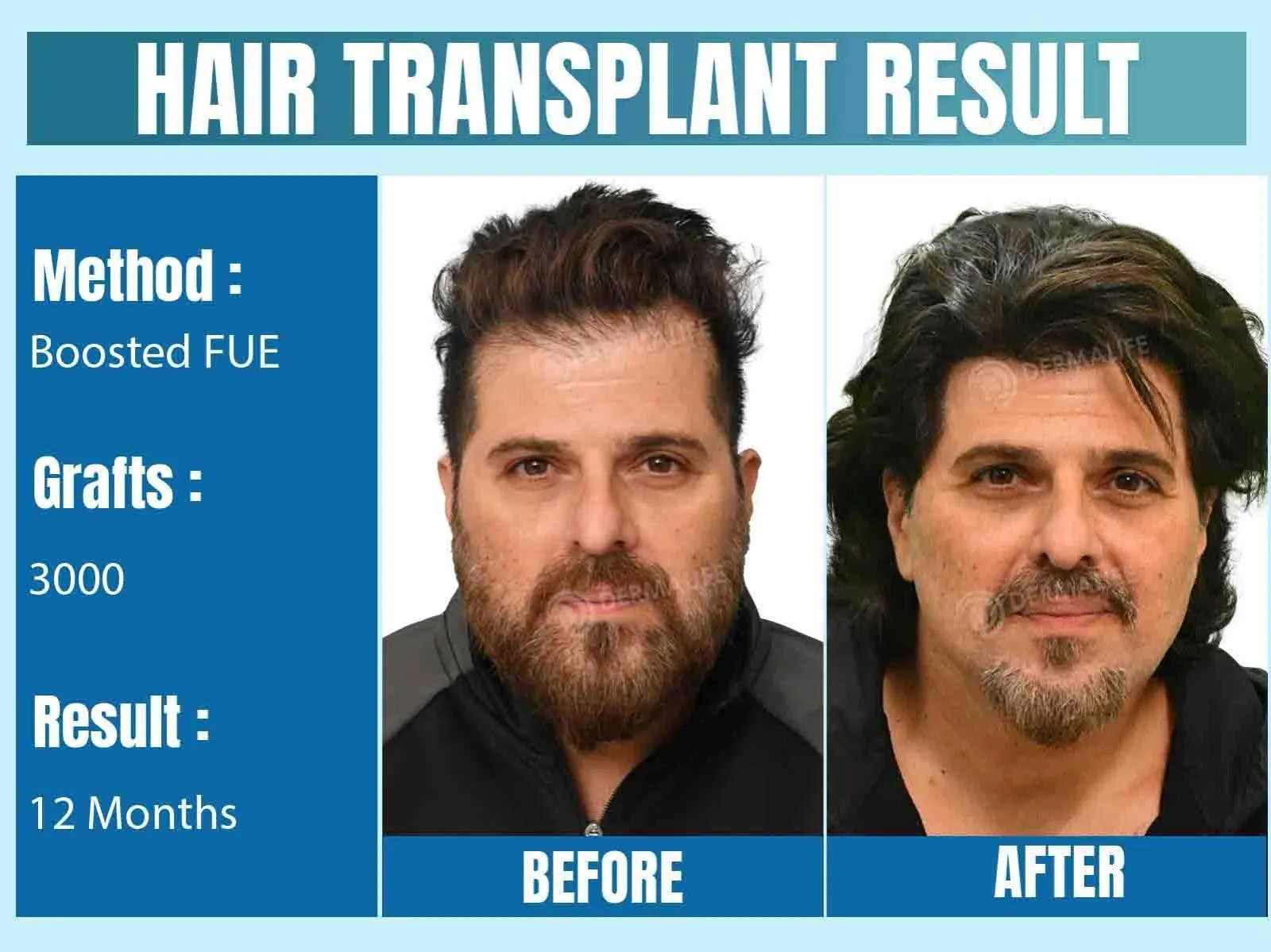
Hair transplantation has developed considerably with improvements in extraction instruments, graft handling, and surgical planning. Among the commonly discussed approaches is Follicular Unit Extraction (FUE), while some clinics also offer specialised variations such as Boosted FUE.
Patients researching hair restoration often ask: What is the difference between FUE and Boosted FUE hair transplant?
To understand the distinction, it is important to look at how follicular units are extracted, handled, and implanted, as well as the specific approach used by the clinic.
What Is FUE Hair Transplant?
FUE stands for Follicular Unit Extraction. It is a hair transplant technique in which individual follicular units are extracted from the donor area, usually the back and sides of the scalp.
These grafts are then prepared and implanted into areas affected by hair loss.
Unlike traditional FUT (Follicular Unit Transplantation), which involves removing a strip of scalp tissue from the donor area, FUE extracts follicular units individually.
The technique generally avoids the linear donor scar associated with strip harvesting. However, it can leave tiny extraction marks, and their visibility depends on factors such as punch size, extraction pattern, healing, and hair length.
What Is Boosted FUE Hair Transplant?
Boosted FUE is the specialised hair transplant approach offered at Dermalife Skin & Hair Clinic under the guidance of Dr. Gaurav Garg.
According to the clinic, the approach uses specialised FUE extraction instruments, jeweller’s forceps, and a graft-handling method described as the “No Root Touch Method”.
The intended focus is careful follicular unit extraction and handling, with the aim of reducing unnecessary manipulation of grafts.
Boosted FUE should be understood as a clinic-specific approach to FUE rather than a universally standardised medical classification. Its suitability and expected outcomes depend on the patient’s scalp characteristics, surgical planning, and how the procedure is performed.
FUE vs Boosted FUE: Key Differences
|
Comparison factor |
Conventional FUE |
Boosted FUE at Dermalife |
|
Full form |
Follicular Unit Extraction |
Clinic-specific specialised FUE approach |
|
Extraction method |
Individual follicular units are extracted using an FUE punch |
Uses specialised FUE extraction instruments |
|
Graft handling |
Grafts are handled and transferred using the clinic’s established protocol |
Clinic describes a “No Root Touch Method” using jeweller’s forceps |
|
Main focus |
Individual graft extraction and transplantation |
Careful extraction and graft handling |
|
Donor area |
Individual extraction points |
Individual extraction points |
|
Hairline design |
Depends on the surgeon’s planning and skill |
Depends on the surgeon’s planning and skill |
|
Graft survival |
Depends on multiple surgical and patient-related factors |
Depends on multiple surgical and patient-related factors |
|
Suitability |
Determined by donor area and patient assessment |
Determined by donor area and patient assessment |
|
Results |
Depends on surgeon expertise, planning, and healing |
Depend on surgeon expertise, planning, and healing |
The comparison describes the clinic’s stated approach. Boosted FUE is not a universally recognised separate category of hair transplantation, and there is no basis for assuming it guarantees better outcomes than every conventional FUE procedure.
1. Differences in Extraction Instruments
In FUE, the surgeon uses a small punch instrument to separate individual follicular units from the donor region.
The size and type of punch may vary depending on hair characteristics, scalp condition, and the surgeon’s technique.
Dermalife’s Boosted FUE approach uses specialised extraction instruments as part of its procedural method. Instrument selection should be based on the patient’s donor characteristics and the surgeon’s assessment.
2. Graft Handling and Preservation
Graft handling is an important part of hair transplant surgery.
After extraction, follicular units must be handled carefully and maintained under appropriate conditions until implantation. Excessive manipulation, dehydration, and prolonged exposure outside suitable storage conditions can affect graft quality.
The Boosted FUE approach at Dermalife incorporates the clinic’s described “No Root Touch Method” and the use of jeweller’s forceps.
The practical goal is to minimise unnecessary handling. However, graft survival is influenced by several factors, and no handling method can guarantee a fixed survival rate for every patient.
3. Hairline Design and Implantation
An important point to understand is that neither FUE nor Boosted FUE automatically determines the final hairline design.
A natural-looking result depends on the surgeon’s planning, including facial proportions, age, hair characteristics, graft selection, implantation angles, and the patient’s future hair loss pattern.
The same principles of careful recipient-site planning apply regardless of the extraction approach.
4. Donor Area Management
Both conventional FUE and Boosted FUE involve individual follicular unit extraction.
The donor area is a limited resource, so extraction must be distributed carefully to avoid visible thinning or overharvesting.
The surgeon should evaluate donor density, hair calibre, follicular unit distribution, and future restoration requirements before deciding how many grafts can safely be extracted.
5. Which Technique Is Better?
There is no universal answer because the choice depends on the patient and the surgeon’s approach.
Some patients may be suitable for conventional FUE, while others may be considered for a clinic’s specialised variation. The important factors are the surgeon’s experience, the extraction and handling protocols, donor management, surgical facilities, and realistic treatment planning.
Patients should ask the hair transplant center to explain the actual differences between the procedures rather than choosing based only on the name of a technique.
Who Is a Suitable Candidate for FUE or Boosted FUE?
Patients with androgenetic alopecia may be considered for hair transplantation if they have a suitable donor area and a stable, medically assessed hair loss pattern.
Before recommending surgery, a doctor should evaluate:
-
The extent and pattern of hair loss
-
Donor area density and quality
-
Hair calibre and texture
-
Existing native hair
-
Age and likely future hair loss
-
Medical conditions affecting the scalp
-
The patient’s expectations
A hair transplant may not be appropriate for every patient, and some may benefit from medical management before surgery.
FUE and Boosted FUE at Dermalife Skin & Hair Clinic
Dermalife Skin & Hair Clinic in Green Park Extension, South Delhi, provides FUE and its specialised Boosted FUE approach under the guidance of Dr. Gaurav Garg, a dermatologist and hair transplant surgeon.
The clinic also offers unshaven hair transplantation, selected beard hair transplant procedures, and corrective hair restoration.
Patients can access free hair transplant consultations to discuss their scalp condition, donor area, expected graft requirements, and the suitability of different approaches.
Final Thoughts
FUE is an established hair transplant technique based on individual follicular unit extraction. Boosted FUE at Dermalife is a clinic-specific approach that focuses on specialised extraction instruments and careful graft handling.
The most important factor is not simply which technique sounds more advanced. It is whether the surgeon selects an appropriate method, manages donor hair responsibly, handles grafts carefully, and plans a natural-looking result according to the patient’s individual needs.
